You brush. You floss. Then you finish with a minty swish of mouthwash, because a clean mouth feels like a healthy one. It might be the most virtuous minute of your day.
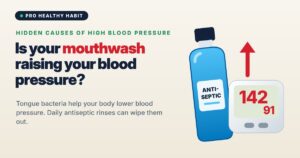
But in one small study, healthy volunteers used an antiseptic mouthwash twice a day for one week. Within a single day, their blood pressure started to rise (Kapil et al., 2013).
The reason has nothing to do with the mint or the alcohol. It has to do with a group of helpful bacteria living on your tongue, and a job they do that most people, and many health professionals, have never heard of.
This article is for education only and isn’t a substitute for personal medical or dental advice. If your dentist prescribed a mouthwash, keep using it as directed and talk to them before making any changes.
Meet Nitric Oxide: Your Blood Vessels’ Relaxer
To understand the mouthwash story, start with a molecule called nitric oxide.
Nitric oxide is a tiny, short-lived gas your body makes on purpose. One of its most important jobs is relaxing the smooth muscle in the walls of your blood vessels. When those walls relax, the vessels widen, blood flows more easily, and blood pressure comes down (Gropper et al., 2018). Medicine already uses this effect: nitroglycerin, the classic pill for chest pain, works by releasing nitric oxide (Gropper et al., 2018).
Your body has two ways to make nitric oxide:
- The inside route. Cells lining your blood vessels make nitric oxide from an amino acid called arginine (Gropper et al., 2018).
- The food route. Your body can also build nitric oxide from nitrate, a natural compound found in vegetables, especially leafy greens and beetroot.
The food route is where your mouth comes in.
The Relay Race in Your Mouth
Here’s the surprising part. Your body can’t easily turn nitrate into nitric oxide on its own. It needs help from bacteria.
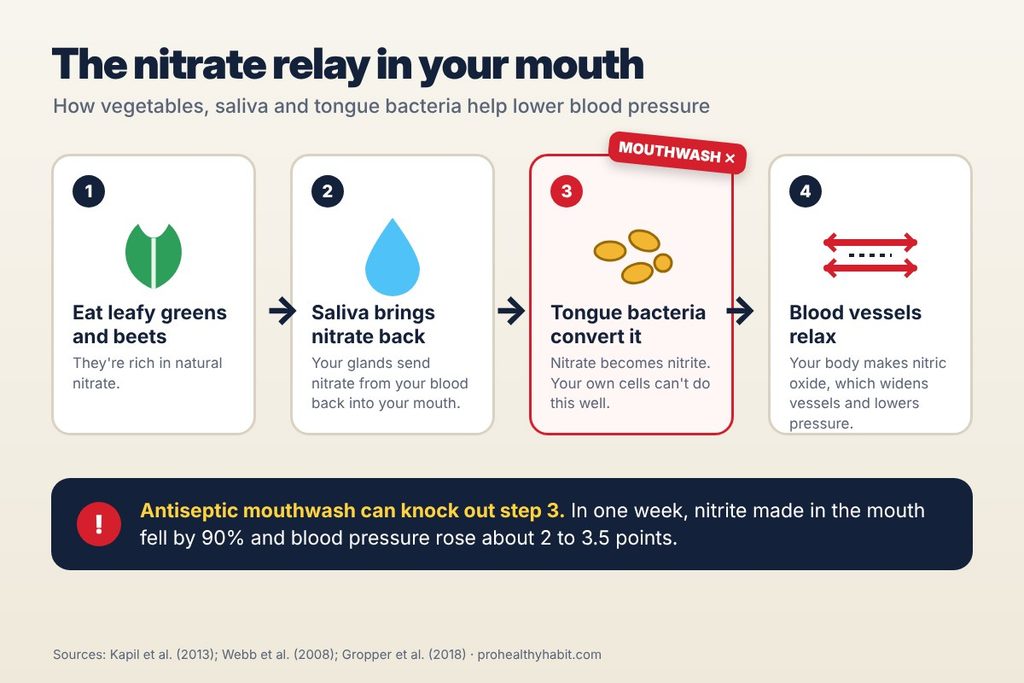
The process works like a relay race:
- You eat nitrate-rich vegetables. Nitrate is absorbed into your blood from your gut.
- Your salivary glands pull nitrate back out of the blood and concentrate it in your saliva. Your body sends it back to your mouth on purpose.
- Bacteria on the back of your tongue take the baton. Certain friendly bacteria convert nitrate into nitrite, something human cells can’t do well by themselves.
- You swallow the nitrite. It’s absorbed and converted into nitric oxide in your blood and tissues, where it helps relax your blood vessels (Kapil et al., 2013; Webb et al., 2008).
Researchers proved how important that mouth step is with a simple experiment. Volunteers drank 500 mL of beetroot juice, which is rich in nitrate. About three hours later, their blood pressure had dropped by roughly 10 points systolic and 8 points diastolic. But when a second group spat out their saliva instead of swallowing it, the blood pressure drop disappeared (Webb et al., 2008).
In other words, the vegetables carry the baton, but the bacteria on your tongue have to hand it off. Without them, the race stops.
What Antiseptic Mouthwash Does to the Relay
Antiseptic mouthwash is designed to kill bacteria. It doesn’t choose between the ones that cause bad breath and the helpful ones that convert nitrate. It knocks out many of the runners in the middle of the relay.
Several small studies have measured what happens next:
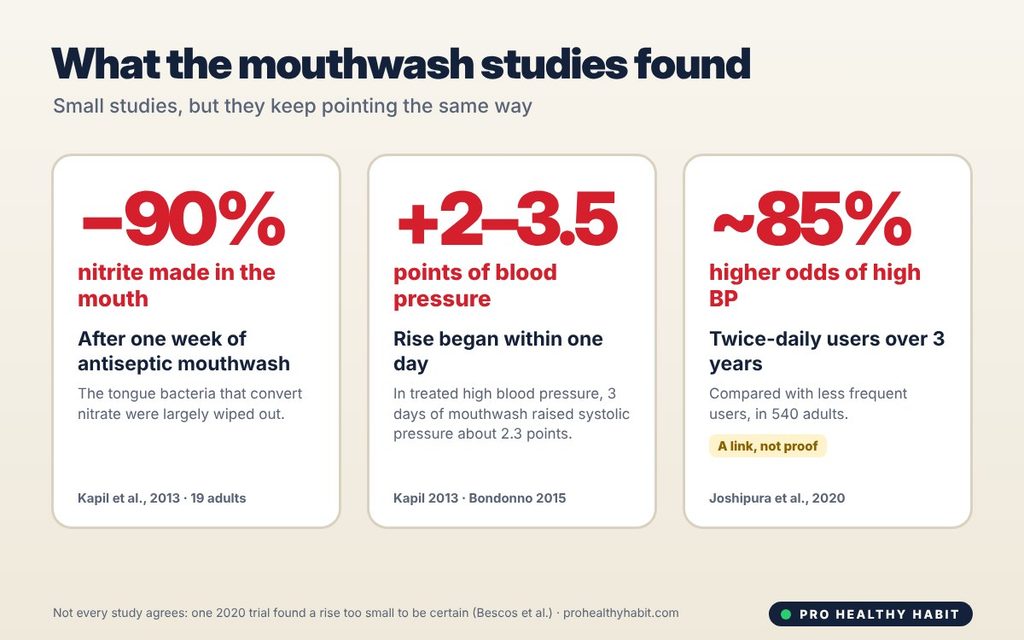
- In healthy adults: Nineteen volunteers used a chlorhexidine mouthwash, a strong antiseptic, twice a day for a week. Their mouths produced 90% less nitrite, nitrite levels in their blood fell by 25%, and their blood pressure rose by about 2 to 3.5 points. The rise appeared within one day and lasted all week (Kapil et al., 2013).
- In people already treated for high blood pressure: Fifteen adults whose blood pressure was being treated used an antibacterial mouthwash for three days. Their systolic blood pressure went up by about 2.3 points compared with rinsing with water (Bondonno et al., 2015).
- Not every study agrees: In a 2020 study of 36 healthy people using chlorhexidine for a week, systolic blood pressure rose, but the change was too small to be statistically certain (Bescos et al., 2020).
A rise of two or three points may not sound like much. For one healthy person it may not matter. But for someone working hard to bring their blood pressure down, with medication, less salt, and more vegetables, it pushes in exactly the wrong direction.
The Long-Term Question: Does Daily Mouthwash Lead to High Blood Pressure?
Short studies show blood pressure moving over days. The bigger question is what happens over years.
A study in Puerto Rico followed 540 overweight or obese adults who didn’t have high blood pressure at the start. Over about three years, people who used mouthwash twice a day or more were about 85% more likely to develop high blood pressure than people who used it less often. Compared with people who didn’t use mouthwash at all, their risk was about twice as high. The link held even among people who had never smoked (Joshipura et al., 2020).
This is an important finding, but it needs careful reading:
- It shows a link, not proof of cause. People who use a lot of mouthwash may differ in other ways that the researchers couldn’t fully measure.
- It studied one group: overweight and obese adults in Puerto Rico. The results may not apply to everyone.
- It fits the biology. The relay-race mechanism gives a plausible reason the link could be real.
The honest summary is that the evidence is suggestive, not settled. But it’s consistent enough that it’s worth thinking about your daily habit, especially if you already have high blood pressure or are at risk for it.
Don’t Swap One Risk for Another: Gum Health Matters Too
Here’s the twist that keeps this story balanced. Poor oral health is also linked to high blood pressure.
A large analysis of studies found that people with moderate to severe gum disease (periodontitis) were more likely to have high blood pressure. Their systolic blood pressure averaged about 4.5 points higher than people with healthy gums (Muñoz Aguilera et al., 2020).
So the goal isn’t a less clean mouth. It’s the right kind of clean: removing plaque and protecting your gums without wiping out the helpful bacteria every single day unless there’s a reason to.
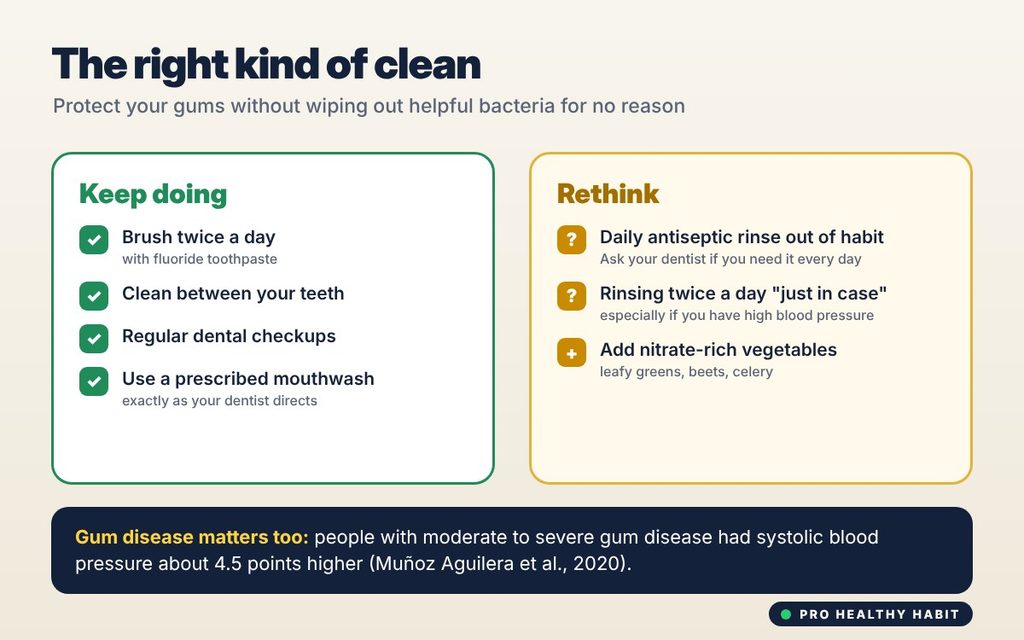
The foundations of oral health remain brushing twice a day with fluoride toothpaste, cleaning between your teeth, and regular dental checkups. For most people, mouthwash is an extra on top of those habits, not a replacement for them.
When Mouthwash Is the Right Call
There are good reasons to use an antiseptic mouthwash, and none of this research says otherwise:
- Your dentist prescribed it, for example to treat gum disease or after dental surgery. Use it exactly as directed and for as long as advised.
- You have a specific dental or medical condition where your dental team recommends it.
- Short-term use for a particular problem is very different from a lifelong twice-a-day habit.
If you have high blood pressure and use an antiseptic mouthwash every day out of habit rather than for a specific reason, it’s a reasonable question to bring to your next dental visit: “Do I actually need this every day?”
Feed the Relay: Nitrate-Rich Vegetables
The other half of the relay is what you eat. The nitrate your tongue bacteria use comes mostly from vegetables.
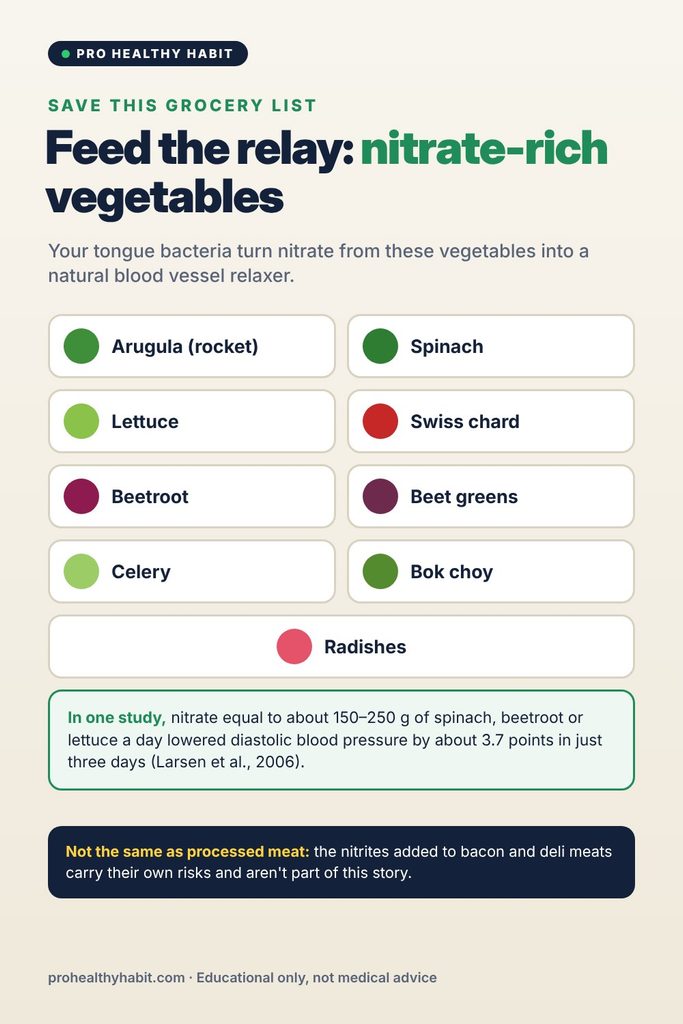
In one early study, healthy volunteers took a dose of nitrate equal to about 150 to 250 grams of spinach, beetroot, or lettuce each day. After just three days, their diastolic blood pressure was about 3.7 points lower (Larsen et al., 2006).
Good everyday sources of nitrate include:
- Leafy greens: arugula (rocket), spinach, lettuce, and Swiss chard
- Beetroot and beet greens
- Celery, bok choy, and radishes
This is one more reason that vegetable-rich eating patterns like the DASH and Mediterranean diets are so good for blood pressure. Whole vegetables are also very different from the nitrites added to processed meats such as bacon and deli meats, which carry their own risks and aren’t part of this story.
Practical Takeaways
- Your tongue bacteria help control blood pressure. They turn nitrate from vegetables into nitrite, which your body uses to relax blood vessels.
- Antiseptic mouthwash can interrupt that process. In small studies, it cut oral nitrite production by about 90% and raised blood pressure by roughly 2 to 3.5 points.
- Long-term evidence is suggestive, not proven. Twice-daily mouthwash use was linked to higher odds of developing high blood pressure over three years.
- Don’t stop a prescribed mouthwash without talking to your dentist.
- Keep the foundations: brush twice a day, clean between your teeth, and see your dentist regularly. Gum disease is linked to higher blood pressure too.
- If you use antiseptic mouthwash out of habit, especially with high blood pressure, ask your dentist whether you need it every day.
- Feed the relay with leafy greens, beetroot, and other nitrate-rich vegetables.
The Bottom Line
A clean mouth is a healthy mouth, but your mouth was never meant to be sterile. Some of the bacteria living on your tongue do a quiet, useful job: they help turn the vegetables you eat into a natural blood vessel relaxer. Daily antiseptic mouthwash can knock out those helpers, and small studies show blood pressure creeping up when that happens.
The evidence isn’t strong enough to tell everyone to throw their mouthwash away, and there are times when it’s exactly the right tool. But if you rinse every day out of habit, especially if you’re working to keep your blood pressure down, it’s worth asking whether you need to. Keep brushing, keep flossing, eat your greens, and let the helpful bacteria do their job.
Medical disclaimer: This article provides general health information and is not medical or dental advice. It does not replace diagnosis or treatment by a qualified healthcare provider. Always speak with your doctor or dentist before changing your oral care routine, diet, or medications, especially if you have high blood pressure, gum disease, or another health condition.
References
Bescos, R., Ashworth, A., Cutler, C., Brookes, Z. L., Belfield, L., Rodiles, A., Casas-Agustench, P., Farnham, G., Liddle, L., Burleigh, M., White, D., Easton, C., & Hickson, M. (2020). Effects of chlorhexidine mouthwash on the oral microbiome. Scientific Reports, 10, Article 5254. https://doi.org/10.1038/s41598-020-61912-4
Bondonno, C. P., Liu, A. H., Croft, K. D., Considine, M. J., Puddey, I. B., Woodman, R. J., & Hodgson, J. M. (2015). Antibacterial mouthwash blunts oral nitrate reduction and increases blood pressure in treated hypertensive men and women. American Journal of Hypertension, 28(5), 572–575. https://doi.org/10.1093/ajh/hpu192
Gropper, S. S., Smith, J. L., & Carr, T. P. (2018). Advanced nutrition and human metabolism (7th ed.). Cengage Learning.
Joshipura, K., Muñoz-Torres, F., Fernández-Santiago, J., Patel, R. P., & Lopez-Candales, A. (2020). Over-the-counter mouthwash use, nitric oxide and hypertension risk. Blood Pressure, 29(2), 103–112. https://doi.org/10.1080/08037051.2019.1680270
Kapil, V., Haydar, S. M. A., Pearl, V., Lundberg, J. O., Weitzberg, E., & Ahluwalia, A. (2013). Physiological role for nitrate-reducing oral bacteria in blood pressure control. Free Radical Biology and Medicine, 55, 93–100. https://doi.org/10.1016/j.freeradbiomed.2012.11.013
Larsen, F. J., Ekblom, B., Sahlin, K., Lundberg, J. O., & Weitzberg, E. (2006). Effects of dietary nitrate on blood pressure in healthy volunteers. New England Journal of Medicine, 355(26), 2792–2793. https://doi.org/10.1056/NEJMc062800
Muñoz Aguilera, E., Suvan, J., Buti, J., Czesnikiewicz-Guzik, M., Barbosa Ribeiro, A., Orlandi, M., Guzik, T. J., Hingorani, A. D., Nart, J., & D’Aiuto, F. (2020). Periodontitis is associated with hypertension: A systematic review and meta-analysis. Cardiovascular Research, 116(1), 28–39. https://doi.org/10.1093/cvr/cvz201
Webb, A. J., Patel, N., Loukogeorgakis, S., Okorie, M., Aboud, Z., Misra, S., Rashid, R., Miall, P., Deanfield, J., Benjamin, N., MacAllister, R., Hobbs, A. J., & Ahluwalia, A. (2008). Acute blood pressure lowering, vasoprotective, and antiplatelet properties of dietary nitrate via bioconversion to nitrite. Hypertension, 51(3), 784–790. https://doi.org/10.1161/HYPERTENSIONAHA.107.103523