Written with input from a physician experienced in medical cannabis assessment and prescribing.
In 2019, doctors in the United Kingdom described a woman in her sixties who had lived almost her entire life without feeling much pain. She needed no painkillers after a major hand operation. Burns and cuts healed quickly, and she said she rarely felt anxious or afraid. When scientists looked at her genes, they found two unusual changes that appear to slow down an enzyme called FAAH. As a result, her blood contained about 70% more of a natural chemical called anandamide than normal (Habib et al., 2019).
Anandamide is one of your body’s own cannabis-like molecules. And the system it belongs to, the endocannabinoid system, helps explain why cannabis does anything to us at all.
In Episode 1 of this series, we cleared away the biggest myths about cannabis. Now we go inside the body. Understanding this system is the key to everything that follows: why THC makes people high, why cannabis can ease some kinds of pain, why it causes the munchies, and why a fatal overdose from cannabis alone is so rare.
A System Discovered Backwards
Most body systems were discovered by studying the body. The endocannabinoid system was found the other way around: by studying a plant.
Scientists identified THC, the main active compound in cannabis, in the 1960s. But for decades, nobody knew how it worked. Then, in 1990, researchers found a receptor in the brain that THC binds to, like a key fitting a lock (Matsuda et al., 1990). They called it the cannabinoid receptor, now known as CB1.
That discovery raised an obvious question. Why would the human brain have a lock built for a plant? The answer arrived in 1992, when a team in Israel found a molecule made by the brain itself that fits the same lock (Devane et al., 1992). They named it anandamide, from the Sanskrit word ananda, meaning “bliss.” A year later, a second receptor, CB2, was found, mostly on immune cells (Munro et al., 1993).
In other words, the receptor wasn’t built for cannabis. Cannabis just happens to fit a system your body was already using.
The Three Parts of the System
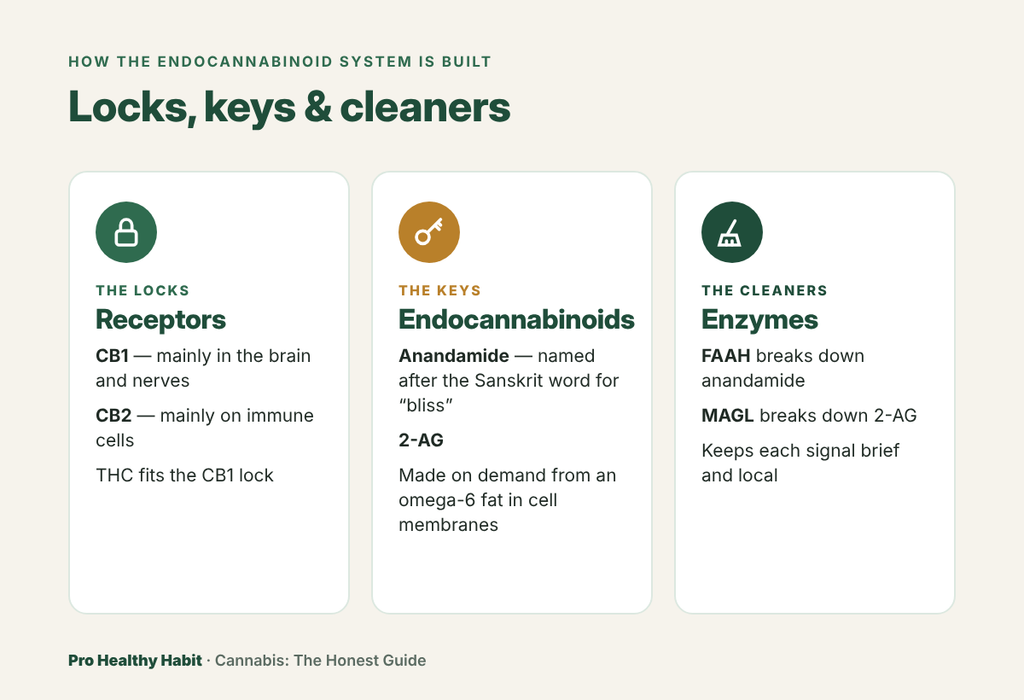
The endocannabinoid system has three main parts. A simple way to remember them: locks, keys, and cleaners.
1. The locks: cannabinoid receptors
- CB1 receptors are found mainly in the brain and nervous system. They are among the most common receptors of their kind in the brain, packed especially densely in areas that control memory, movement, and emotion (Herkenham et al., 1990; Lu & Mackie, 2016).
- CB2 receptors are found mainly on immune cells. They help regulate inflammation, which is why they attract so much interest for inflammatory conditions (Munro et al., 1993).
2. The keys: endocannabinoids
Your body makes two main cannabis-like messengers: anandamide and 2-AG (2-arachidonoylglycerol). Both are built from arachidonic acid, an omega-6 fatty acid that is stored in the membranes of your cells (Gropper et al., 2018; Devane et al., 1992). In that sense, they’re made from fat, not from protein like many other brain messengers.
3. The cleaners: enzymes
Once the message is delivered, enzymes break the keys down quickly. FAAH breaks down anandamide, and another enzyme, MAGL, breaks down 2-AG (Lu & Mackie, 2016). This is exactly what was different in the woman described above: her FAAH worked more slowly, so her anandamide stayed around longer.
How It Works: Your Body’s Dimmer Switch
Most brain chemicals are made in advance, stored, and released when needed. Endocannabinoids work differently, in three ways that make them unusual.
They’re made on demand. Your cells produce endocannabinoids only at the moment they’re needed, then the enzymes clear them away. The effect is local and brief.
They travel backward. Normally, a nerve cell sends a signal forward across a tiny gap to the next cell. Endocannabinoids are released by the receiving cell and travel backward to the sending cell, where they tell it to quiet down (Lu & Mackie, 2016). Scientists call this retrograde signalling.
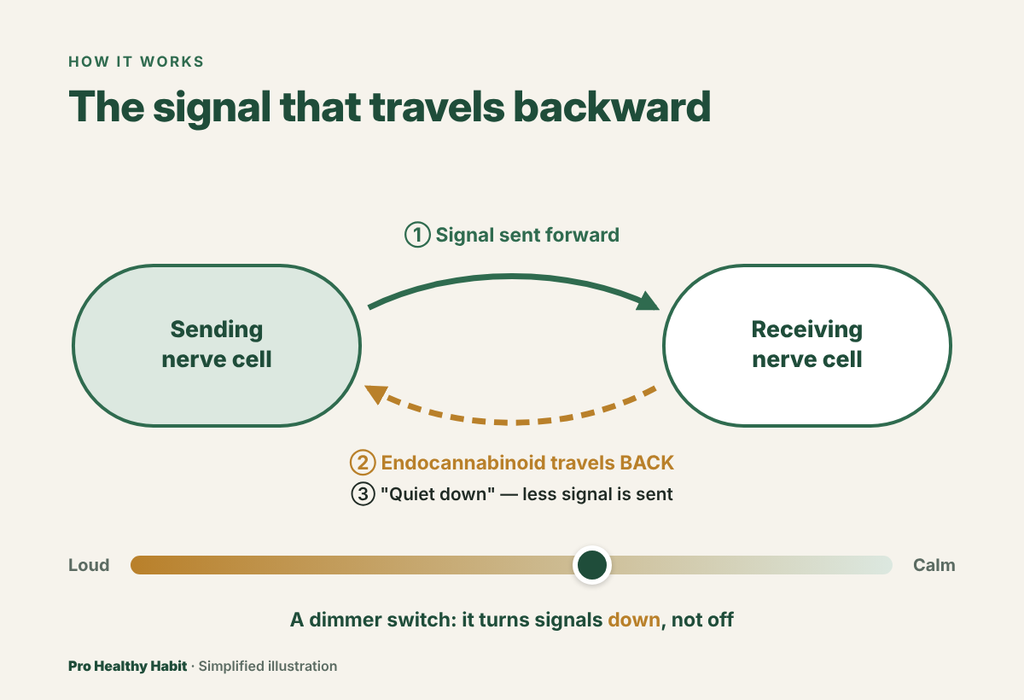
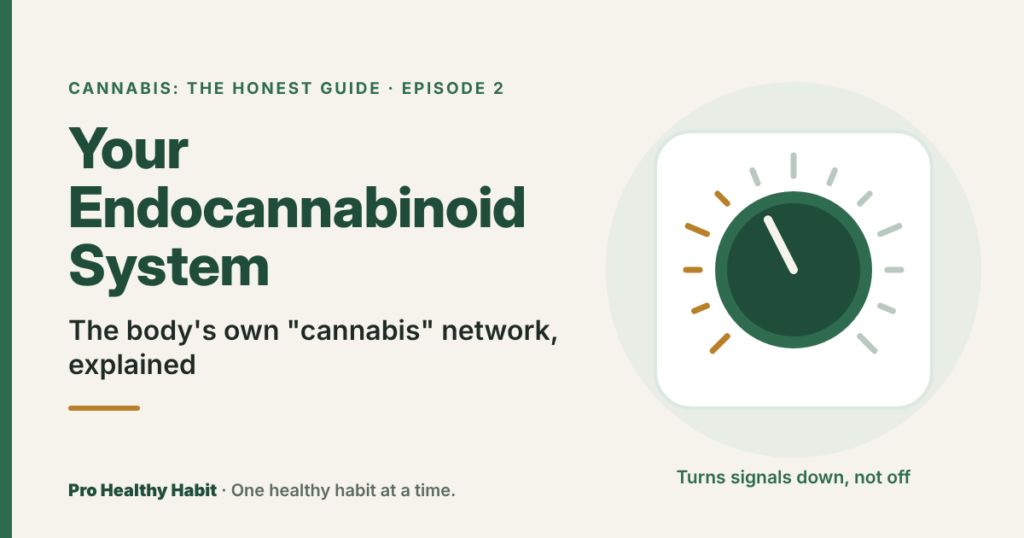
They turn things down, not off. Because of this backward signal, the endocannabinoid system works like a dimmer switch. When a signal gets too loud (too much pain, too much stress, too much nerve activity), the system turns it down to a more comfortable level.
This dimmer switch is involved in a remarkable range of everyday functions, including pain, stress and anxiety, appetite, memory, sleep, movement, and inflammation (Lu & Mackie, 2016). That breadth is also why cannabis affects so many different things at once.
Three Real-World Clues About What This System Does
Scientists have learned a lot about the endocannabinoid system from cases where it’s turned up or turned down.
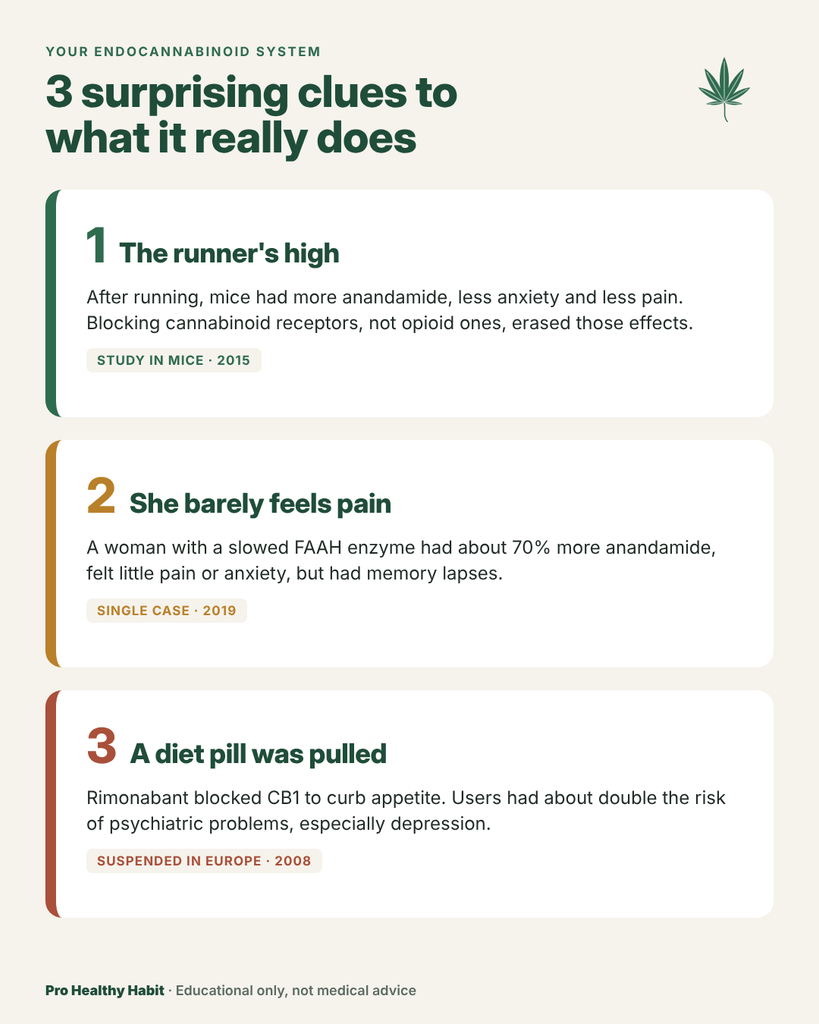
Clue 1: The runner’s high may not be endorphins
For decades, the “runner’s high” was credited to endorphins, the body’s natural opioids. A 2015 study in mice suggested the endocannabinoid system plays a bigger role than expected. After running, the mice had higher anandamide levels, along with less anxiety-like behaviour and lower pain sensitivity. When researchers blocked cannabinoid receptors, those calming and pain-relieving effects disappeared. Blocking opioid receptors did not remove them (Fuss et al., 2015).
An important caveat: this was a study in mice, and mice can’t tell us how they feel. But it’s a strong hint that exercise naturally turns up your own endocannabinoid system.
Clue 2: A woman who barely feels pain
The case at the start of this article is a natural experiment. With her FAAH enzyme slowed, her anandamide stayed high, and she experienced very little pain and anxiety. She also reported memory lapses, such as forgetting words or where she left her keys (Habib et al., 2019). That trade-off matters. Turning the dimmer up affects pain and memory, not just one or the other. This is a single case, so researchers are careful about drawing broad conclusions, but it shows how powerfully this system shapes everyday experience.
Clue 3: A diet pill that blocked the system
If turning the system up reduces pain and anxiety, what happens if you turn it down? In the 2000s, a weight-loss drug called rimonabant was designed to block CB1 receptors and reduce appetite. It did help some people lose weight, but people taking it had roughly double the risk of psychiatric problems, especially depression, compared with placebo. European regulators recommended suspending the drug in 2008 because the risks outweighed the benefits (European Medicines Agency, 2008).
The lesson: the endocannabinoid system isn’t just about pleasure or the munchies. It’s woven into how we regulate mood, and blocking it can have serious consequences.
Where Cannabis Fits In
Now we can answer the question from the start of this series: why does cannabis do anything at all?
THC fits the CB1 lock. It acts a lot like anandamide, but with two big differences. Your own endocannabinoids are released in specific places, only when needed, and are cleared within moments. THC reaches CB1 receptors throughout the brain and body at the same time, and it lasts for hours. If your endocannabinoid system is a set of dimmer switches in individual rooms, THC is like turning many of them at once, all over the house.
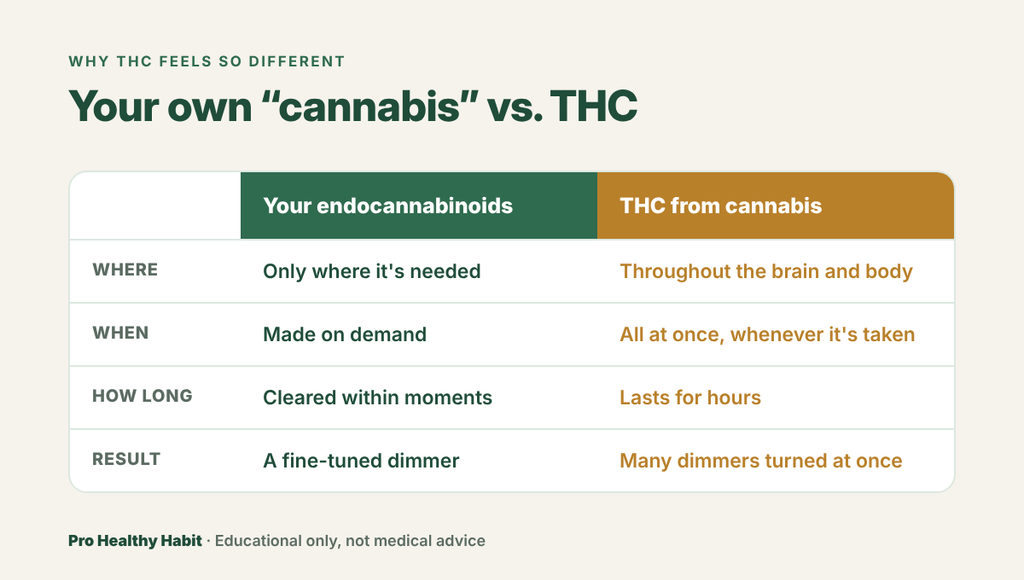
That explains much of what people experience with THC:
- Pain relief, because the system dims pain signals.
- The munchies, because the system helps regulate appetite.
- Short-term memory problems, because CB1 is dense in memory centres.
- Clumsiness and slower reactions, because CB1 is dense in areas that control movement.
- Anxiety or paranoia at higher doses, because flooding a finely tuned system doesn’t always calm it.
CBD works differently. It doesn’t activate CB1 the way THC does, which is why it doesn’t cause a high. CBD acts on many different targets in the body, and scientists are still working out exactly how. We’ll compare THC and CBD in detail in the next article.
Why cannabis alone rarely causes a fatal overdose
Here’s one more answer from biology. Opioids can be deadly because they act on parts of the brainstem that control breathing. CB1 receptors, by contrast, are sparse in the lower brainstem areas that control breathing and heart function (Herkenham et al., 1990). The researchers who mapped these receptors suggested this may explain why even very high doses of THC are not lethal. As we covered in Episode 1, that doesn’t make cannabis harmless. Too much can still cause panic, vomiting, a racing heart, and emergency-room visits. But it helps explain one of the biggest differences between cannabis and opioids.
A Word of Caution About “Balancing Your ECS”
Once you know about the endocannabinoid system, you’ll start seeing it in marketing everywhere: products that promise to “support,” “balance,” or “restore” your ECS.
Here’s the honest picture. Some researchers have proposed a theory called clinical endocannabinoid deficiency, suggesting that low endocannabinoid activity might contribute to conditions such as migraine, fibromyalgia, and irritable bowel syndrome (Russo, 2016). It’s an interesting idea, and it deserves more research. But it is still a hypothesis, not an established diagnosis. There is no routine test for an “endocannabinoid deficiency,” and no product has been proven to “balance” this system in healthy people.
Using our series evidence scale:
| Claim | Evidence level |
|---|---|
| Your body has an endocannabinoid system that regulates pain, mood, appetite, and memory | Strong |
| Exercise boosts your own endocannabinoids | Limited (strong animal evidence, less in humans) |
| “Endocannabinoid deficiency” causes conditions like migraine or fibromyalgia | Limited (a hypothesis under study) |
| Supplements can “balance your ECS” in healthy people | Not supported |
Practical Takeaways
- You have a built-in cannabis-like system. The endocannabinoid system existed long before anyone used cannabis. The plant just happens to fit into it.
- Think locks, keys, and cleaners. Receptors (CB1, CB2), messengers (anandamide, 2-AG), and the enzymes that clear them away.
- It works like a dimmer switch. It turns down signals that get too loud, including pain, stress, and nerve activity.
- THC floods the system. It acts everywhere at once and for hours, which explains both its benefits and its side effects.
- Blocking the system can harm mood. A weight-loss drug that blocked CB1 was suspended because of psychiatric side effects.
- Few CB1 receptors control breathing. That helps explain why fatal overdose from cannabis alone is rare, though too much can still cause serious problems.
- Be sceptical of “ECS balancing” products. The science doesn’t support those claims in healthy people.
- Move your body. Exercise appears to naturally boost your own endocannabinoids, at least in animal studies, and it has many other proven benefits.
The Bottom Line
The endocannabinoid system is one of the most fascinating discoveries in modern biology, and most people have never heard of it. It’s a network of receptors, messengers, and enzymes that quietly adjusts pain, mood, appetite, memory, and inflammation throughout your day, working like a dimmer switch rather than an on-off button.
Cannabis affects us because its compounds plug into this existing system. Understanding that helps make sense of everything else in this series: why cannabis can ease certain kinds of pain, why it affects memory and coordination, why it can cause anxiety in some people, and why THC and CBD behave so differently. Next, we’ll put those two molecules side by side: THC vs. CBD, and the hundreds of other compounds in the plant.
https://www.youtube.com/watch?v=DRGEPN0GnAc
Medical disclaimer: This article is for general educational purposes only and is not a substitute for professional medical advice, diagnosis, or treatment. Cannabis laws vary by country and region. Always consult a qualified healthcare provider before starting, stopping, or changing any treatment, including cannabis or cannabis-based products.
References
Devane, W. A., Hanuš, L., Breuer, A., Pertwee, R. G., Stevenson, L. A., Griffin, G., Gibson, D., Mandelbaum, A., Etinger, A., & Mechoulam, R. (1992). Isolation and structure of a brain constituent that binds to the cannabinoid receptor. Science, 258(5090), 1946–1949. https://doi.org/10.1126/science.1470919
European Medicines Agency. (2008, October 23). The European Medicines Agency recommends suspension of the marketing authorisation of Acomplia [Press release]. https://europeansources.info/?p=423857
Fuss, J., Steinle, J., Bindila, L., Auer, M. K., Kirchherr, H., Lutz, B., & Gass, P. (2015). A runner’s high depends on cannabinoid receptors in mice. Proceedings of the National Academy of Sciences, 112(42), 13105–13108. https://doi.org/10.1073/pnas.1514996112
Gropper, S. S., Smith, J. L., & Carr, T. P. (2018). Advanced nutrition and human metabolism (7th ed.). Cengage Learning.
Habib, A. M., Okorokov, A. L., Hill, M. N., Bras, J. T., Lee, M.-C., Li, S., Gossage, S. J., van Drimmelen, M., Morena, M., Houlden, H., Ramirez, J. D., Bennett, D. L. H., Srivastava, D., & Cox, J. J. (2019). Microdeletion in a FAAH pseudogene identified in a patient with high anandamide concentrations and pain insensitivity. British Journal of Anaesthesia, 123(2), e249–e253. https://doi.org/10.1016/j.bja.2019.02.019
Herkenham, M., Lynn, A. B., Little, M. D., Johnson, M. R., Melvin, L. S., de Costa, B. R., & Rice, K. C. (1990). Cannabinoid receptor localization in brain. Proceedings of the National Academy of Sciences, 87(5), 1932–1936. https://doi.org/10.1073/pnas.87.5.1932
Lu, H.-C., & Mackie, K. (2016). An introduction to the endogenous cannabinoid system. Biological Psychiatry, 79(7), 516–525. https://doi.org/10.1016/j.biopsych.2015.07.028
Matsuda, L. A., Lolait, S. J., Brownstein, M. J., Young, A. C., & Bonner, T. I. (1990). Structure of a cannabinoid receptor and functional expression of the cloned cDNA. Nature, 346(6284), 561–564. https://doi.org/10.1038/346561a0
Munro, S., Thomas, K. L., & Abu-Shaar, M. (1993). Molecular characterization of a peripheral receptor for cannabinoids. Nature, 365(6441), 61–65. https://doi.org/10.1038/365061a0
Russo, E. B. (2016). Clinical endocannabinoid deficiency reconsidered: Current research supports the theory in migraine, fibromyalgia, irritable bowel, and other treatment-resistant syndromes. Cannabis and Cannabinoid Research, 1(1), 154–165. https://doi.org/10.1089/can.2016.0009