Written with input from a physician experienced in medical cannabis assessment and prescribing.
Ask ten people what they think about cannabis and you’ll likely hear two very different stories. One says it’s a natural, harmless plant that can treat almost anything. The other says it’s a dangerous drug that ruins lives. Both stories are told loudly, and both are wrong in important ways.
Here’s what’s not in dispute: cannabis is the most widely used drug in the world after alcohol, nicotine, and caffeine. The United Nations estimates that about 256 million people used cannabis in 2024 (UNODC, 2026). In Canada, where it has been legal since 2018, 26% of people aged 16 and older reported using it for non-medical reasons in the past year (Health Canada, 2024). Yet for something so common, accurate information is surprisingly hard to find. Much of what’s online comes from companies selling products, or from people with a strong position to defend.
Welcome to a new series at Pro Healthy Habit: Cannabis: The Honest Guide. Over the coming articles we’ll cover how cannabis works in the body, what the research shows for pain and other conditions, the real risks, how to reduce harm, and how to talk with your doctor. Our promise is simple: we won’t sell you a miracle, and we won’t try to scare you. We’ll tell you what the evidence supports, how strong that evidence is, and where it runs out.
One important note before we begin: this series is educational, not personal medical advice. Cannabis laws differ widely between countries and regions, so always check the rules where you live, and talk with your healthcare provider before using cannabis for any health reason.
What Is Cannabis, Exactly?
Cannabis refers to plants of the Cannabis sativa species. The plant contains more than a hundred natural compounds called cannabinoids, along with aromatic compounds called terpenes that give different varieties their smell.
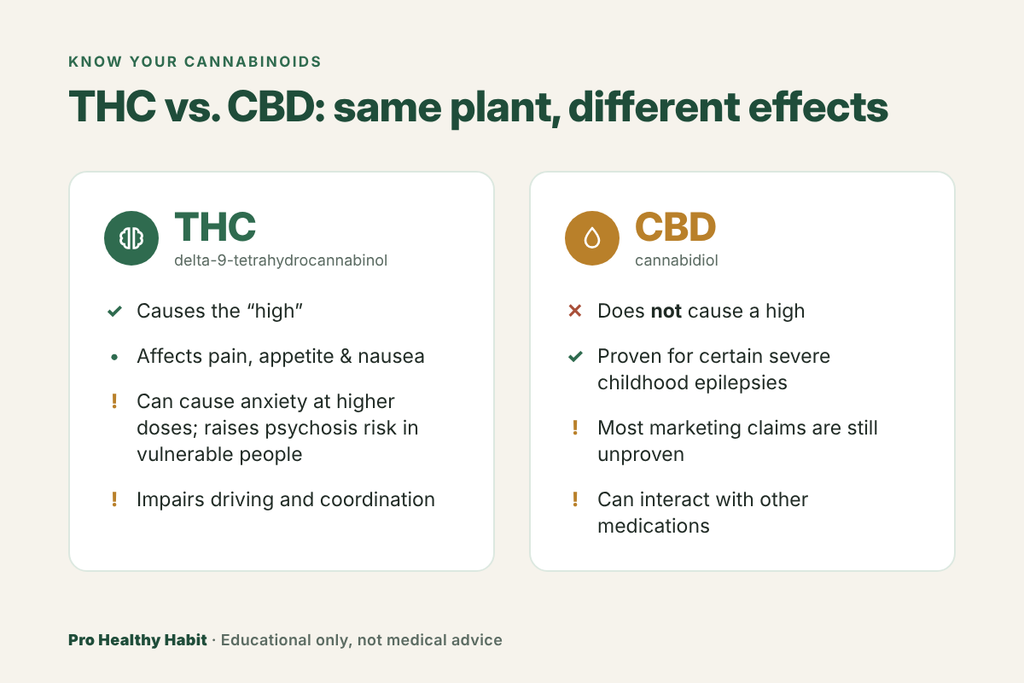
Two cannabinoids get most of the attention:
- THC (delta-9-tetrahydrocannabinol) is the main compound responsible for the “high.” It also affects pain, appetite, and nausea.
- CBD (cannabidiol) does not cause a high. It acts on the body very differently from THC, and it has one well-established medical use that we’ll discuss below.
These compounds work because your body already has a system built to respond to them: the endocannabinoid system, a network of receptors and natural signalling molecules involved in pain, mood, appetite, sleep, and inflammation. It’s one of the most fascinating systems in human biology, and it’s the subject of our next article.
Medical vs. recreational: a blurrier line than you’d think
People often divide cannabis use into “medical” and “recreational.” In reality, the line is blurry. Many people who buy cannabis from a regular store are using it to manage sleep, stress, or pain, without ever discussing it with a clinician. Others have a medical authorization but use products similar to those sold recreationally.
The real difference isn’t the plant. It’s the process. Medical use ideally involves a clinician who reviews your condition, your other medications, and your risks, then helps you choose a product and monitors how it’s working. That oversight is what makes medical use safer, and it’s the part most people skip.
A Quick Look at the Law Around the World
Because this series has readers in many countries, here’s the big picture. Cannabis law ranges from full legalization to strict prohibition:
- Full legalization for adults: Uruguay became the first country to legalize recreational cannabis in 2013, followed by Canada in 2018. Canada also has one of the world’s longest-running medical cannabis programs.
- Partial or mixed models: Germany legalized limited personal possession and home growing in 2024. In the United States, laws vary state by state. At the federal level, marijuana was moved from Schedule I to Schedule III in April 2026, but this initially applied only to state-legal medical cannabis and FDA-approved cannabis drugs; recreational use remains federally illegal (Pittman, 2026).
- Medical access only: Many countries, including the United Kingdom and Australia, allow cannabis-based medicines through a prescription under specific conditions.
- Prohibition: In many other countries, cannabis remains fully illegal, sometimes with severe penalties.
One rule applies almost everywhere: carrying cannabis across an international border is illegal, even when you’re travelling between two places where it’s legal.
Myth-Busting in Both Directions
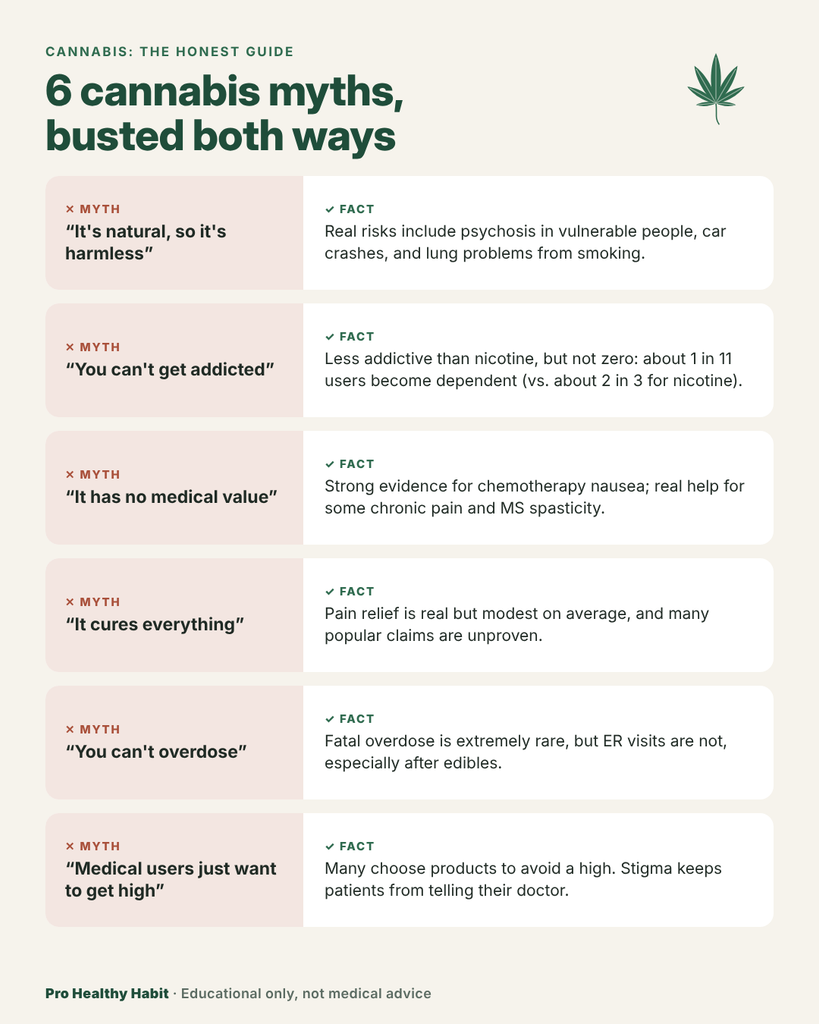
The fastest way to understand cannabis is to clear away the myths. Notice that these myths come from both camps.
Myth 1: “It’s natural, so it’s harmless.”
Being natural doesn’t make something safe. Poison ivy is natural too. Cannabis has real, well-documented risks. A major report from the U.S. National Academies of Sciences, Engineering, and Medicine (NASEM), which reviewed more than 10,000 studies, found substantial evidence that cannabis use increases the risk of developing schizophrenia and other psychoses (with the highest risk among the most frequent users), that driving after use raises the risk of motor vehicle crashes, and that long-term smoking is linked to chronic bronchitis symptoms (NASEM, 2017).
Myth 2: “You can’t get addicted to cannabis.”
The honest answer sits in between. Cannabis is clearly less addictive than nicotine, but it can still lead to real dependence. A large U.S. national survey estimated how many users eventually become dependent on a substance: about 2 in 3 people who use nicotine, compared with about 1 in 11 people who use cannabis (Lopez-Quintero et al., 2011).
Doctors call problematic use cannabis use disorder, and it’s diagnosed on a spectrum from mild to severe. Many cases are mild and look more like a hard-to-break habit than a classic addiction. But the risk climbs with how often people use. In another large U.S. survey, nearly 3 in 10 people who had used cannabis in the past year met the criteria for cannabis use disorder, including milder cases (Hasin et al., 2015). Signs include using more than intended, failed attempts to cut back, cravings, and continued use despite problems at work, school, or home.
Withdrawal is real too. About half of regular users who cut back or stop experience withdrawal symptoms such as irritability, poor sleep, reduced appetite, and cravings, and daily use makes this more likely (Bahji et al., 2020). Cannabis withdrawal is uncomfortable rather than dangerous, unlike withdrawal from alcohol. The bottom line: most people who use cannabis won’t become dependent, but some will, and the risk rises with daily use and with starting at a young age.
Myth 3: “Cannabis has no medical value.”
This one is also wrong. The same NASEM report found conclusive evidence that oral cannabinoids help with nausea and vomiting caused by chemotherapy, and substantial evidence that cannabis or cannabinoids help with chronic pain in adults and with muscle spasticity in multiple sclerosis (NASEM, 2017). Separately, a high-quality randomized trial showed that purified CBD reduced seizures in children with Dravet syndrome, a severe form of epilepsy (Devinsky et al., 2017), which led to approval of a prescription CBD medicine.
Myth 4: “Cannabis cures everything.”
It doesn’t, and this is where the honest middle matters most. For many popular claims (anxiety, depression, PTSD, and many others), the NASEM review found the evidence was limited or insufficient (NASEM, 2017). Even for chronic pain, where evidence is strongest, the benefit is real but modest. A 2021 meta-analysis in The BMJ pooled 32 randomized trials involving more than 5,000 patients and found that non-inhaled medical cannabis or cannabinoids produced small to very small improvements in pain, physical function, and sleep compared with placebo (Wang et al., 2021). And claims that cannabis cures cancer are not supported by human evidence.
“Modest on average” doesn’t mean useless. Some individuals respond well, and others don’t respond at all. That’s exactly why careful, individual assessment matters, and we’ll explore it in depth in our pain article.
Myth 5: “You can’t overdose on cannabis.”
This myth is half right. Unlike opioids, cannabis doesn’t shut down the brain’s breathing centres, so a fatal overdose from cannabis alone is extraordinarily rare. But taking too much can still send you to the emergency room with severe anxiety, panic, a racing heart, vomiting, confusion, or in some people temporary psychotic symptoms. Edibles are a common culprit, because their effects can take an hour or two to start, which tempts people to take more. Children who accidentally eat cannabis edibles can become seriously ill.
Myth 6: “People who use medical cannabis are just looking for an excuse to get high.”
This stigma does real harm. Many people who use cannabis medically are older adults with chronic pain, people going through cancer treatment, or people living with neurological conditions, and many choose products specifically to avoid feeling high. Judging them doesn’t make anyone safer. It just makes them less likely to tell their doctor.
Why Stigma Is a Safety Problem
Stigma isn’t just unkind. It’s dangerous, because it keeps people quiet. In one U.S. study in family medicine clinics, doctors were aware of their patients’ medical cannabis use only about half the time (Kondrad et al., 2018). The authors noted that discomfort and stigma likely played a role.
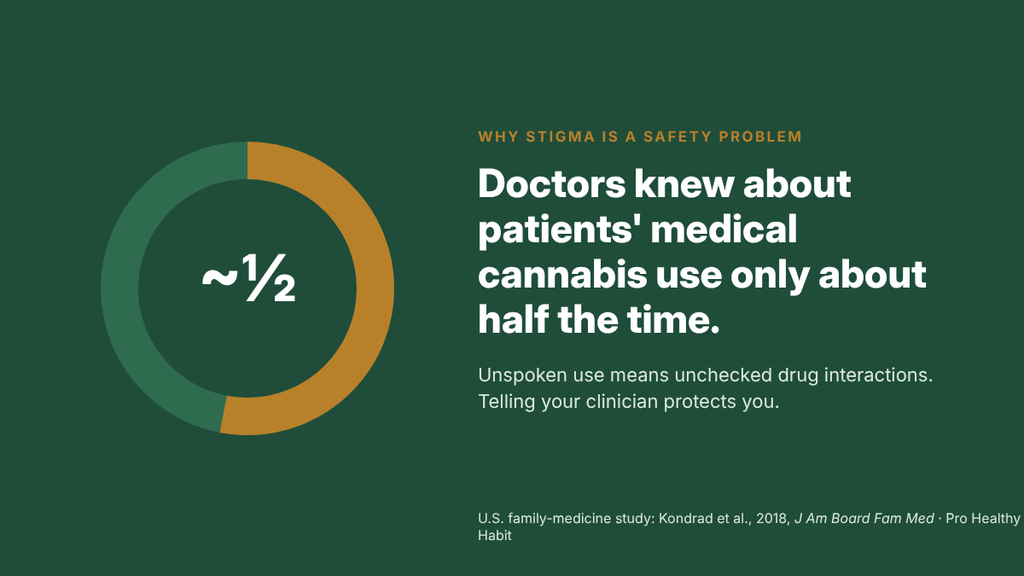
Why does this matter? Because cannabis interacts with other medications, including some blood thinners, seizure medications, and sedatives, and it affects conditions like heart disease and mental health. When your clinician doesn’t know you use cannabis, they can’t watch for those interactions.
A pattern clinicians commonly see goes like this: a person living with long-term nerve pain starts using cannabis on their own, choosing a strong product from an unregulated source because they’re too embarrassed to ask anyone. They don’t mention it at appointments. When side effects or interactions appear, nobody connects the dots. The same person, given a non-judgmental conversation, could have been guided toward a safer product, a lower dose, and proper monitoring.
The takeaway: whatever your reason for using cannabis, telling your healthcare provider is one of the most protective things you can do. A good clinician’s job is to keep you safe, not to judge you.
How We’ll Grade the Evidence in This Series
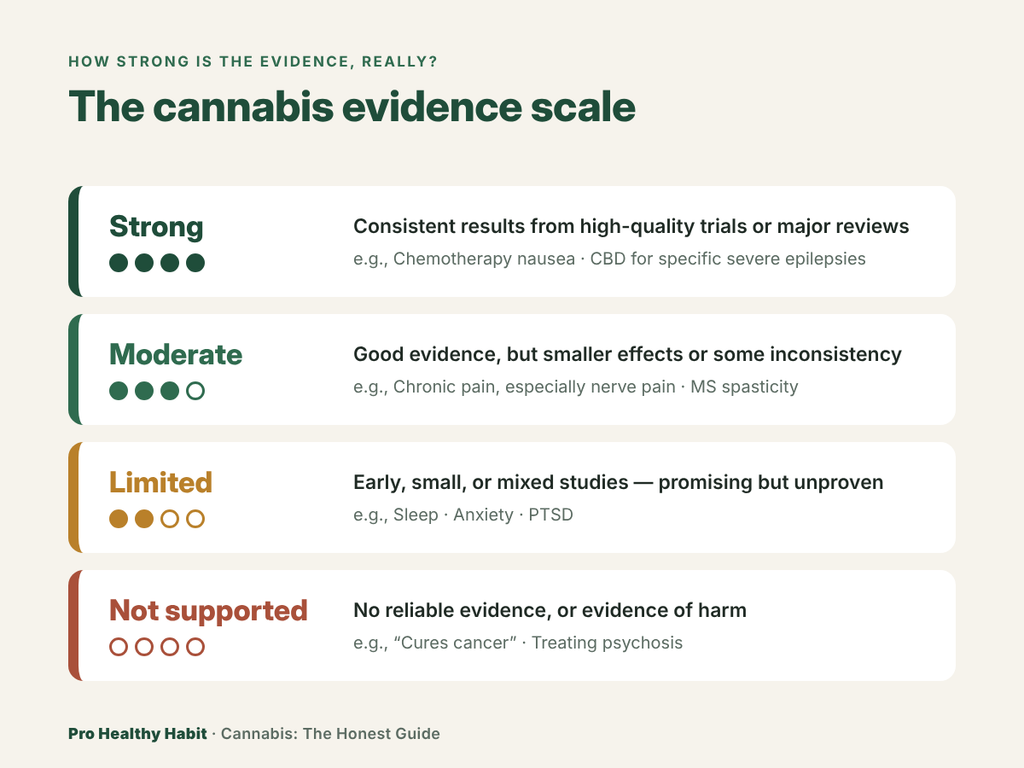
To keep things honest, every claim in this series will be labelled by how strong the evidence is. Here’s the key:
| Evidence level | What it means | Example |
|---|---|---|
| Strong | Consistent results from high-quality randomized trials or major reviews | Chemotherapy-related nausea; CBD for specific severe epilepsies |
| Moderate | Good evidence, but with smaller effects or some inconsistency | Chronic pain, especially nerve pain; MS spasticity |
| Limited | Early, small, or mixed studies; promising but unproven | Sleep, anxiety, PTSD |
| Not supported | No reliable evidence, or evidence of harm | “Cures cancer”; treating psychosis |
When you see a claim about cannabis anywhere online, ask the question this table is built on: How strong is the evidence, really?
Practical Takeaways
- Cannabis is neither a miracle nor a menace. It has real, modest medical benefits for specific conditions, and real risks.
- The evidence is strongest for chemotherapy-related nausea, chronic pain (especially nerve pain), MS spasticity, and CBD for certain severe epilepsies.
- Many popular claims are unproven. Anxiety, depression, PTSD, and “cures cancer” lack reliable evidence.
- Less addictive than nicotine, but not zero. About 1 in 11 users become dependent (vs. about 2 in 3 for nicotine), and the risk rises with daily use.
- “Natural” doesn’t mean safe. Risks include psychosis in vulnerable people, impaired driving, and lung problems from smoking.
- Edibles need patience. Effects can take an hour or two to begin. Store them safely away from children and pets.
- Laws vary. Check the rules where you live, and never carry cannabis across a border.
- Tell your healthcare provider. Honest conversations prevent dangerous drug interactions.
The Bottom Line
Cannabis sits at the centre of one of the loudest debates in modern health, and most of the noise comes from people with something to sell or something to prove. The science tells a more useful story. Cannabis contains compounds that genuinely affect pain, nausea, muscle spasm, and seizures, and for some people the benefit is meaningful. It also carries real risks, from dependence (less common than with nicotine, but real) to psychosis to impaired driving, and it’s not the cure-all its biggest fans claim.
The goal of this series is to help you understand both sides clearly, so you can make informed choices and have open, honest conversations with your healthcare team. Next, we’ll look at the remarkable system inside your body that explains why cannabis does anything at all: your endocannabinoid system.
Medical disclaimer: This article is for general educational purposes only and is not a substitute for professional medical advice, diagnosis, or treatment. Cannabis laws vary by country and region. Always consult a qualified healthcare provider before starting, stopping, or changing any treatment, including cannabis or cannabis-based products.
References
Bahji, A., Stephenson, C., Tyo, R., Hawken, E. R., & Seitz, D. P. (2020). Prevalence of cannabis withdrawal symptoms among people with regular or dependent use of cannabinoids: A systematic review and meta-analysis. JAMA Network Open, 3(4), e202370. https://doi.org/10.1001/jamanetworkopen.2020.2370
Devinsky, O., Cross, J. H., Laux, L., Marsh, E., Miller, I., Nabbout, R., Scheffer, I. E., Thiele, E. A., & Wright, S. (2017). Trial of cannabidiol for drug-resistant seizures in the Dravet syndrome. New England Journal of Medicine, 376(21), 2011–2020. https://doi.org/10.1056/NEJMoa1611618
Hasin, D. S., Saha, T. D., Kerridge, B. T., Goldstein, R. B., Chou, S. P., Zhang, H., Jung, J., Pickering, R. P., Ruan, W. J., Smith, S. M., Huang, B., & Grant, B. F. (2015). Prevalence of marijuana use disorders in the United States between 2001–2002 and 2012–2013. JAMA Psychiatry, 72(12), 1235–1242. https://doi.org/10.1001/jamapsychiatry.2015.1858
Health Canada. (2024). Canadian Cannabis Survey 2024: Summary. Government of Canada. https://www.canada.ca/en/health-canada/services/drugs-medication/cannabis/research-data/canadian-cannabis-survey-2024-summary.html
Kondrad, E. C., Reed, A. J., Simpson, M. J., & Nease, D. E., Jr. (2018). Lack of communication about medical marijuana use between doctors and their patients. Journal of the American Board of Family Medicine, 31(5), 805–808. https://doi.org/10.3122/jabfm.2018.05.170462
Lopez-Quintero, C., Pérez de los Cobos, J., Hasin, D. S., Okuda, M., Wang, S., Grant, B. F., & Blanco, C. (2011). Probability and predictors of transition from first use to dependence on nicotine, alcohol, cannabis, and cocaine: Results of the National Epidemiologic Survey on Alcohol and Related Conditions (NESARC). Drug and Alcohol Dependence, 115(1–2), 120–130. https://doi.org/10.1016/j.drugalcdep.2010.11.004
National Academies of Sciences, Engineering, and Medicine. (2017). The health effects of cannabis and cannabinoids: The current state of evidence and recommendations for research. The National Academies Press. https://doi.org/10.17226/24625
Pittman, L. (2026, Summer). Marijuana finally rescheduled after 55 years. TortSource. American Bar Association. https://www.americanbar.org/groups/tort_trial_insurance_practice/resources/tortsource/2026-summer/marijuana-finally-rescheduled-after-55-years
United Nations Office on Drugs and Crime. (2026). World drug report 2026. United Nations. https://www.unodc.org/unodc/en/data-and-analysis/world-drug-report.html
Wang, L., Hong, P. J., May, C., Rehman, Y., Oparin, Y., Hong, C. J., Hong, B. Y., AminiLari, M., Gallo, L., Kaushal, A., … Busse, J. W. (2021). Medical cannabis or cannabinoids for chronic non-cancer and cancer related pain: A systematic review and meta-analysis of randomised clinical trials. BMJ, 374, n1034. https://doi.org/10.1136/bmj.n1034