Imagine taking two, three, even four blood pressure pills every day, and your numbers still won’t come down. Now imagine that the real cause has a name, shows up on a simple blood test, and can sometimes be treated at its source. Yet the test is almost never ordered.
That isn’t a thought experiment. In Alberta, researchers looked at the records of 1.1 million adults with high blood pressure. Only 0.7% of them had ever been screened for this cause (Liu et al., 2021).
The cause is called primary aldosteronism. It happens when the adrenal glands make too much of a hormone called aldosterone. It used to be considered rare. It isn’t. And because it damages the heart, brain, and kidneys more than ordinary high blood pressure does, it may be one of the most important conditions you’ve never heard of.
This article is for education only and isn’t a substitute for personal medical advice. Please don’t change or stop any blood pressure medication without talking to your healthcare provider.
Meet Aldosterone: Your Body’s Salt Manager
To understand what goes wrong, it helps to know what aldosterone normally does.
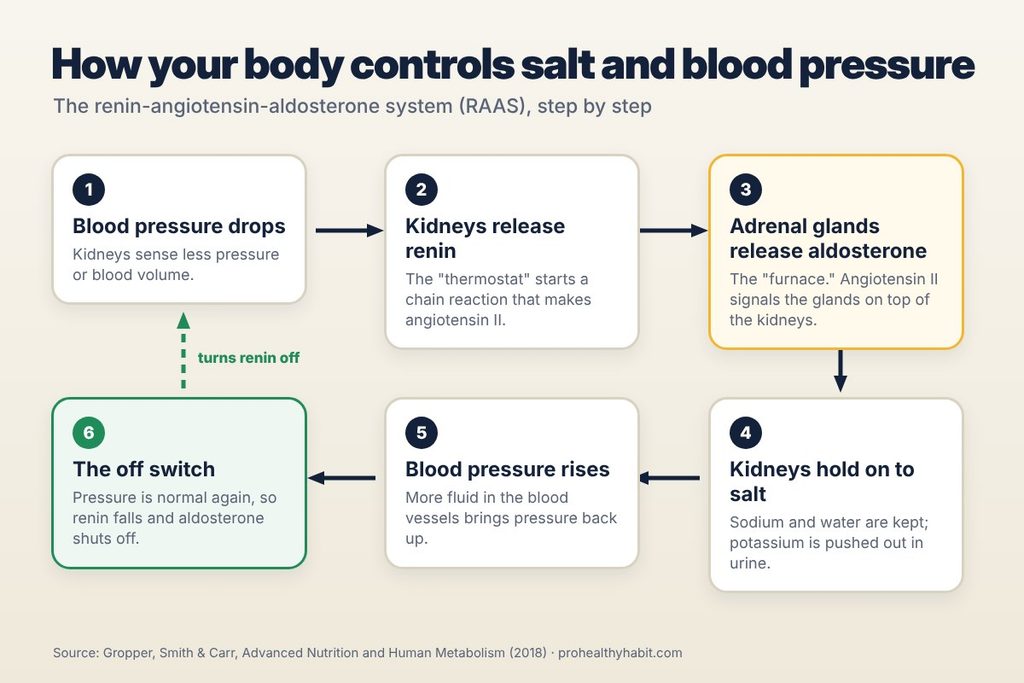
Your body keeps careful control over how much salt and water it holds, because that balance sets your blood volume and your blood pressure. The main control system is called the renin-angiotensin-aldosterone system, or RAAS (Gropper et al., 2018).
Here’s how it works, step by step:
- The kidneys sense a drop. When blood pressure or blood volume falls, special cells in the kidneys release an enzyme called renin.
- A chain reaction begins. Renin sets off a series of steps that produces angiotensin II, a hormone that tightens blood vessels and raises blood pressure.
- The adrenal glands answer. Angiotensin II signals the adrenal glands, two small glands sitting on top of the kidneys, to release aldosterone.
- Aldosterone holds on to salt. In the kidneys, aldosterone adds more sodium channels and pumps, so the body keeps more sodium. Water follows the sodium, so blood volume and blood pressure rise. At the same time, aldosterone makes the kidneys get rid of more potassium (Gropper et al., 2018).
The most important part is the off switch. Once blood pressure is back to normal, renin release slows, aldosterone falls, and the kidneys let extra sodium go in the urine (Gropper et al., 2018). Aldosterone directly controls only about 8% of the sodium the kidneys filter. But because the kidneys filter so much fluid each day, that small share adds up to a large amount of salt (Gropper et al., 2018).
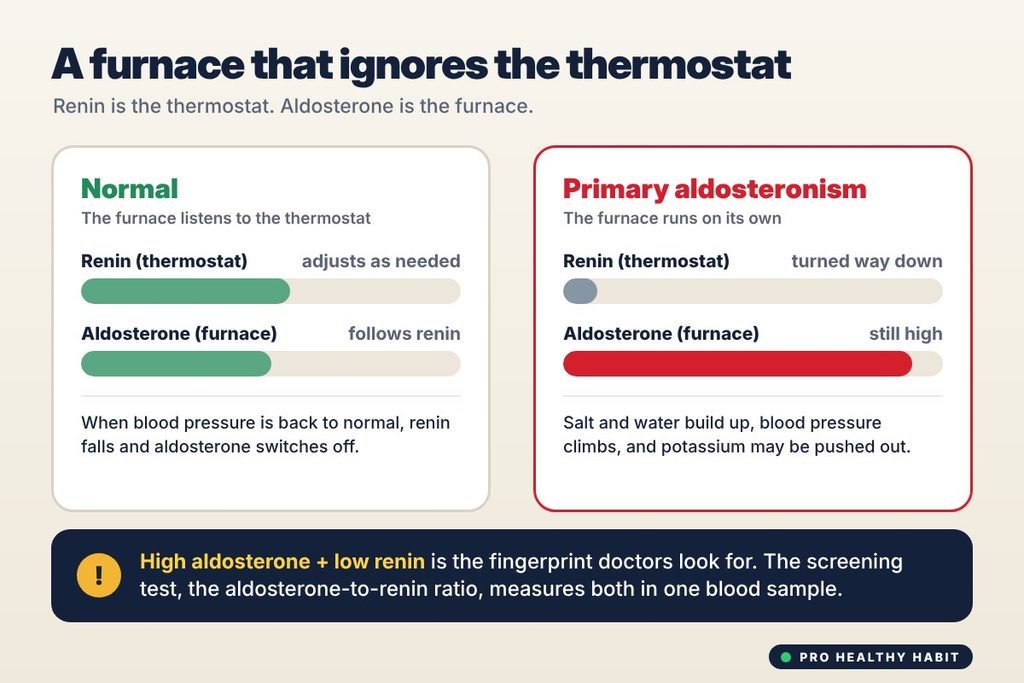
Think of it like a home heating system. Renin is the thermostat: it senses when things are low and calls for heat. Aldosterone is the furnace. When the room is warm enough, the thermostat tells the furnace to shut off.
What Goes Wrong: A Furnace That Ignores the Thermostat
In primary aldosteronism, the adrenal glands make aldosterone on their own, whether the body needs it or not. Sometimes the cause is a small benign growth (an adenoma) on one adrenal gland. Sometimes both glands are overactive.
Either way, the furnace keeps running even though the room is already hot. The body holds on to too much salt and water, so blood pressure climbs. The thermostat notices the excess and does exactly what it should: it turns renin down, often to very low levels. But the furnace ignores it.
That pattern is the key to diagnosis. High aldosterone together with low renin is the fingerprint of primary aldosteronism. A normal system would never pair the two.
More Common Than Anyone Thought
For decades, doctors were taught that primary aldosteronism was rare and that you could spot it by low blood potassium. Both ideas have been overturned.
It’s common. The 2025 Endocrine Society guideline estimates that it affects about 5% to 14% of people with high blood pressure seen in primary care, and many more among people whose blood pressure is hard to control (Adler et al., 2025). A U.S. study that tested everyone thoroughly, rather than only people who seemed suspicious, found clear-cut primary aldosteronism in roughly 16% to 22% of people with high blood pressure, depending on how severe their blood pressure was. The authors concluded that the condition is common and largely unrecognized (Brown et al., 2020).
Most people have normal potassium. Because aldosterone pushes potassium out, low potassium was long treated as the warning sign. But only a minority of people with primary aldosteronism, roughly 9% to 37% across studies, actually have low potassium (Funder et al., 2016). Waiting for low potassium means missing most cases.
Almost nobody is tested. The Alberta study is a striking example. Of 1.1 million adults with high blood pressure, 7,941 were screened. About 1 in 5 of those screened (21.4%) had a positive result. And only 731 people, fewer than half of those who screened positive, went on to receive treatment aimed at the condition (Liu et al., 2021).
Why It Matters: More Damage at the Same Blood Pressure
You might think high blood pressure is high blood pressure, whatever the cause. But extra aldosterone does harm that goes beyond the pressure reading itself.
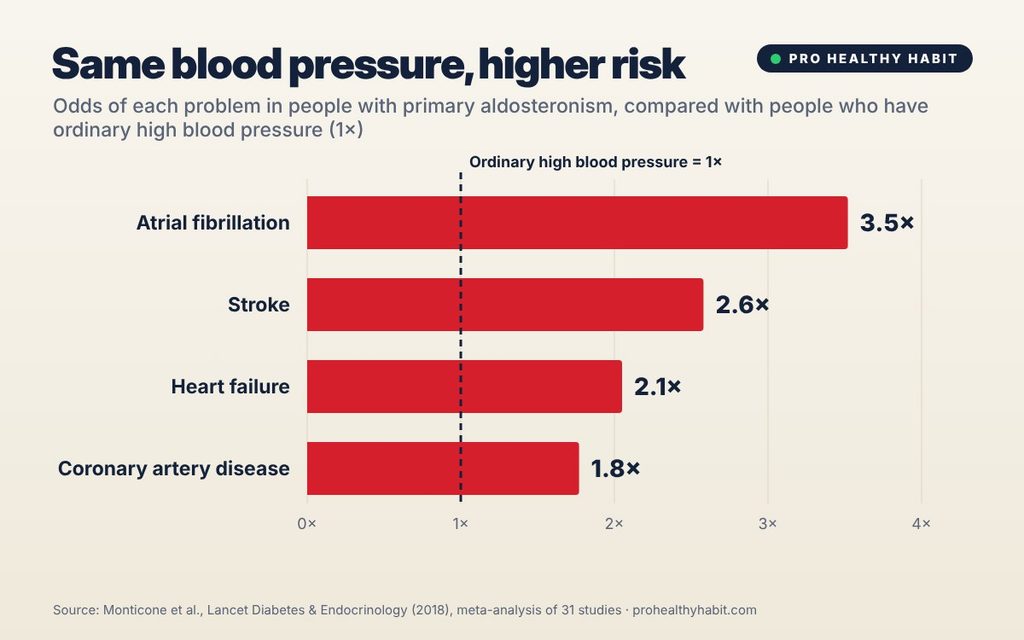
A large analysis of 31 studies compared more than 3,800 people with primary aldosteronism to more than 9,200 people with ordinary high blood pressure. Compared with ordinary high blood pressure, people with primary aldosteronism had (Monticone et al., 2018):
- About 2.6 times the odds of stroke
- About 3.5 times the odds of atrial fibrillation, an irregular heart rhythm that raises stroke risk
- About 2 times the odds of heart failure
- About 1.8 times the odds of coronary artery disease
Why? Too much aldosterone appears to drive inflammation and scarring (fibrosis) in the heart, blood vessels, and kidneys. In other words, the furnace isn’t just overheating the house. It’s slowly damaging the walls.
This is also why the specific diagnosis matters. Ordinary blood pressure pills can lower the number on the cuff without shutting down the aldosterone that is causing the damage.
The Test: One Blood Draw
The screening test is simple and inexpensive. It measures aldosterone and renin in one blood sample and compares them, which gives the aldosterone-to-renin ratio (Adler et al., 2025). A potassium level is usually checked at the same time.
If the screen is positive, an endocrinologist (a hormone specialist) usually does further tests. These confirm the diagnosis and work out whether one adrenal gland or both are responsible. That answer decides the treatment.
A few practical points:
- Some medications can affect the results. Your provider may interpret the results with your medications in mind, or occasionally adjust them before retesting. Never stop a blood pressure medication on your own to prepare for a test.
- A negative result isn’t always final. If your blood pressure later gets harder to control, retesting may make sense (Adler et al., 2025).
Who Should Ask About Testing?
In 2025, the Endocrine Society updated its guidance to suggest screening everyone with high blood pressure for primary aldosteronism (Adler et al., 2025). This is a major shift from older advice, which limited testing to high-risk groups.
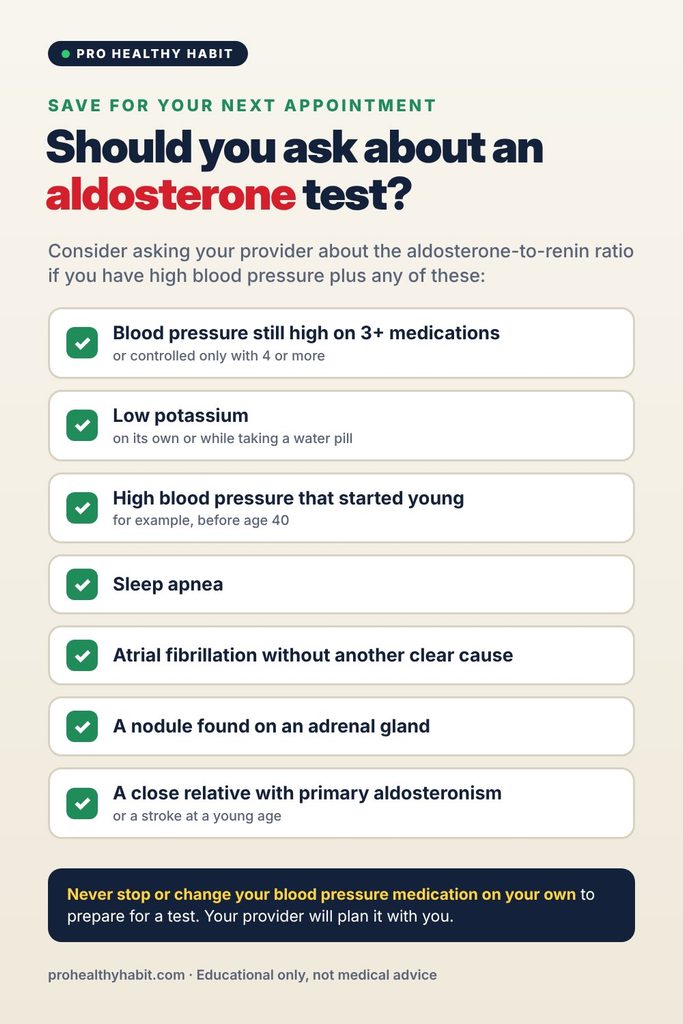
Guidance differs between organizations and countries. Hypertension Canada, for example, recommends considering screening in specific higher-risk groups. But nearly all guidance agrees that testing is especially worth discussing if you have:
- Resistant high blood pressure: still high despite three or more medications, or controlled only with four or more
- Low potassium, whether it appeared on its own or while taking a water pill (diuretic)
- High blood pressure that started young, for example before age 40
- Sleep apnea together with high blood pressure
- Atrial fibrillation without another clear cause
- A nodule found on an adrenal gland during a scan done for another reason
- A close relative with primary aldosteronism, or with a stroke at a young age
If any of these apply to you, it’s reasonable to ask your doctor: “Could my blood pressure be caused by aldosterone? Should I have an aldosterone-renin test?”
The Good News: It’s Treatable, Sometimes at the Source
What makes primary aldosteronism worth finding is that it has targeted treatments.
When one adrenal gland is the source, surgery to remove that gland (adrenalectomy) can be offered. In a large international study of 705 patients, 94% had their hormone levels fully corrected after surgery. Blood pressure was completely normalized without medication in 37%, and improved in another 47% (Williams et al., 2017). Many people still need some medication afterward, but often fewer pills.
When both glands are involved, or surgery isn’t the right choice, medications called mineralocorticoid receptor antagonists are used. These include spironolactone and eplerenone, and they block aldosterone’s effects. How well they work can be tracked. In one study, patients whose renin stayed suppressed despite treatment had higher rates of heart events. Patients whose renin rose with treatment did about as well as people with ordinary high blood pressure (Hundemer et al., 2018). In effect, a rising renin means the thermostat is working again.
A new class of medicine is arriving. Aldosterone synthase inhibitors reduce how much aldosterone the body makes in the first place. In a 2025 trial of nearly 800 people with hard-to-control blood pressure, baxdrostat lowered systolic blood pressure by about 9 to 10 points more than placebo after 12 weeks (Flack et al., 2025). These drugs are still new, and whether they are available, and for whom, depends on where you live.
Where Nutrition Fits In: The Salt Connection
Primary aldosteronism is a hormonal condition, so diet can’t cure it. But diet matters more here than in almost any other kind of high blood pressure, for one reason: salt.
Aldosterone’s job is to hold on to sodium. When aldosterone is already too high, a high-salt diet gives it more to work with. Researchers believe that too much aldosterone combined with high salt intake is what drives much of the heart and blood vessel damage (Schneider et al., 2023).
The encouraging part is that cutting back helps. In the small Salt CONNtrol study, 41 people with primary aldosteronism who were already on medication reduced their salt intake from about 9.1 to 5.2 grams a day over 12 weeks. Their systolic blood pressure dropped from about 130 to 121 mmHg, and their mood improved as well (Schneider et al., 2023). The study had no comparison group, so the results need confirming. But they fit what the biology predicts.
Most of the salt we eat doesn’t come from the salt shaker. More than 75% of dietary sodium comes from salt added to processed foods (Gropper et al., 2018). The biggest sources include:
- Deli meats and cured meats
- Canned soups
- Pizza
- Condiments such as soy sauce and ketchup
- Bread
- Salty snacks
Cooking more often from fresh, whole ingredients, as in the DASH and Mediterranean eating patterns, is one of the most effective changes.
One important caution about potassium. Because aldosterone pushes potassium out, it’s tempting to add potassium supplements or potassium-based salt substitutes. Don’t do this on your own. The main treatments for primary aldosteronism raise potassium, and too much potassium can cause dangerous heart rhythm problems. If you have primary aldosteronism, or think you might, talk to your provider before using salt substitutes or potassium supplements. Getting potassium from ordinary fruits and vegetables as part of a balanced diet is a different matter. Your care team can guide you.
Practical Takeaways
- Primary aldosteronism is common, not rare. It may explain high blood pressure in roughly 1 in 20 to 1 in 7 people seen in primary care, and even more among those with hard-to-control blood pressure.
- You can’t rule it out by feel or by potassium. Most people with it have normal potassium and no special symptoms.
- It’s more dangerous than ordinary high blood pressure. At the same blood pressure, it carries higher odds of stroke, atrial fibrillation, and heart failure.
- The screening test is one blood draw. It’s the aldosterone-to-renin ratio. Ask about it, especially if you have any of the risk factors listed above.
- Don’t stop any medication on your own to prepare for testing. Let your provider plan it.
- It’s treatable. Surgery can correct the hormone levels when one gland is the source, and targeted medications work when both are involved.
- Salt matters more here. Cutting back on processed, salty foods supports treatment.
- Be careful with potassium supplements and salt substitutes. Check with your provider first.
The Bottom Line
High blood pressure is often treated as a single disease, managed by adding one pill after another. But for a meaningful share of people, there’s a specific, testable cause underneath: adrenal glands making aldosterone without listening to the body’s signals. It’s common and often missed. It’s harder on the heart, brain, and kidneys than ordinary high blood pressure. And finding it opens the door to treatment that targets the cause instead of only the number.
The test is simple. The hardest part is remembering to ask. If you have high blood pressure, especially if it’s stubborn, started young, or comes with low potassium or sleep apnea, ask your provider whether an aldosterone-renin test makes sense for you.
Medical disclaimer: This article provides general health information and is not medical advice. It does not replace diagnosis or treatment by a qualified healthcare provider. Always speak with your doctor or pharmacist before changing your diet, supplements, or medications, especially if you have high blood pressure, kidney disease, or a heart condition.
References
Adler, G. K., Stowasser, M., Correa, R. R., Khan, N., Kline, G., McGowan, M. J., Mulatero, P., Murad, M. H., Touyz, R. M., Vaidya, A., Williams, T. A., Yang, J., Young, W. F., Jr., Zennaro, M.-C., & Brito, J. P. (2025). Primary aldosteronism: An Endocrine Society clinical practice guideline. The Journal of Clinical Endocrinology & Metabolism, 110(9), 2453–2495. https://doi.org/10.1210/clinem/dgaf284
Brown, J. M., Siddiqui, M., Calhoun, D. A., Carey, R. M., Hopkins, P. N., Williams, G. H., & Vaidya, A. (2020). The unrecognized prevalence of primary aldosteronism: A cross-sectional study. Annals of Internal Medicine, 173(1), 10–20. https://doi.org/10.7326/M20-0065
Flack, J. M., Azizi, M., Brown, J. M., Dwyer, J. P., Fronczek, J., Jones, E. S. W., Olsson, D. S., Williams, B., & BaxHTN Investigators. (2025). Efficacy and safety of baxdrostat in uncontrolled and resistant hypertension. New England Journal of Medicine, 393(14), 1363–1374. https://doi.org/10.1056/NEJMoa2507109
Funder, J. W., Carey, R. M., Mantero, F., Murad, M. H., Reincke, M., Shibata, H., Stowasser, M., & Young, W. F., Jr. (2016). The management of primary aldosteronism: Case detection, diagnosis, and treatment: An Endocrine Society clinical practice guideline. The Journal of Clinical Endocrinology & Metabolism, 101(5), 1889–1916. https://doi.org/10.1210/jc.2015-4061
Gropper, S. S., Smith, J. L., & Carr, T. P. (2018). Advanced nutrition and human metabolism (7th ed.). Cengage Learning.
Hundemer, G. L., Curhan, G. C., Yozamp, N., Wang, M., & Vaidya, A. (2018). Cardiometabolic outcomes and mortality in medically treated primary aldosteronism: A retrospective cohort study. The Lancet Diabetes & Endocrinology, 6(1), 51–59. https://doi.org/10.1016/S2213-8587(17)30367-4
Liu, Y.-Y., King, J., Kline, G. A., Padwal, R. S., Pasieka, J. L., Chen, G., So, B., Harvey, A., Chin, A., & Leung, A. A. (2021). Outcomes of a specialized clinic on rates of investigation and treatment of primary aldosteronism. JAMA Surgery, 156(6), 541–549. https://doi.org/10.1001/jamasurg.2021.0254
Monticone, S., D’Ascenzo, F., Moretti, C., Williams, T. A., Veglio, F., Gaita, F., & Mulatero, P. (2018). Cardiovascular events and target organ damage in primary aldosteronism compared with essential hypertension: A systematic review and meta-analysis. The Lancet Diabetes & Endocrinology, 6(1), 41–50. https://doi.org/10.1016/S2213-8587(17)30319-4
Schneider, H., Sarkis, A.-L., Sturm, L., Britz, V., Lechner, A., Potzel, A. L., Müller, L. M., Heinrich, D. A., Künzel, H., Nowotny, H. F., Seiter, T. M., Kunz, S., Bidlingmaier, M., Reincke, M., & Adolf, C. (2023). Moderate dietary salt restriction improves blood pressure and mental well-being in patients with primary aldosteronism: The salt CONNtrol trial. Journal of Internal Medicine, 294(1), 47–57. https://doi.org/10.1111/joim.13618
Williams, T. A., Lenders, J. W. M., Mulatero, P., Burrello, J., Rottenkolber, M., Adolf, C., Satoh, F., Amar, L., Quinkler, M., Deinum, J., Beuschlein, F., Kitamoto, K. K., Pham, U., Morimoto, R., Umakoshi, H., Prejbisz, A., Kocjan, T., Naruse, M., Stowasser, M., … Reincke, M. (2017). Outcomes after adrenalectomy for unilateral primary aldosteronism: An international consensus on outcome measures and analysis of remission rates in an international cohort. The Lancet Diabetes & Endocrinology, 5(9), 689–699. https://doi.org/10.1016/S2213-8587(17)30135-3