Introduction: Why Nutrients Matter More Than Ever
In today’s fast-paced world of processed snacks, restrictive diets, and wellness trends, it’s easy to lose sight of what our bodies actually need to function well. Amidst all the noise, one truth remains clear: good nutrition is the foundation of good health.
But what does “good nutrition” really mean? It starts with understanding the essential nutrients—those the body can’t produce in adequate amounts on its own, and must therefore be obtained through food (or supplements when necessary)
What Are Essential Nutrients?
Essential nutrients fall into two major categories:
- Macronutrients: Needed in larger quantities (carbohydrates, proteins, fats, and water).
- Micronutrients: Needed in smaller amounts (vitamins and minerals), but no less important.
They play critical roles in everything from building tissues and regulating metabolism to supporting the immune system and brain function
Macronutrients: The Body’s Fuel
1. Carbohydrates
- Role: Primary energy source, especially for the brain.
- Sources: Whole grains, fruits, legumes, and vegetables.
- Recommended Intake: 45–65% of daily calories for adults
✅ Pro Tip: Choose complex carbs (like oats and quinoa) over simple sugars for lasting energy.
Want to dive deeper into how carbohydrates fuel your body, which types to prioritize, and how much you actually need?
→ Read our complete guide to carbohydrates: The Body’s Preferred Fuel Source
2. Proteins: The Body’s Master Builders
Proteins are often hailed as the most essential building blocks of life—and for good reason. Every single cell in your body contains protein. It’s involved in nearly every process your body performs, from muscle movement to hormone production and immune response.
🔧 What Do Proteins Do?
- Build and repair muscles, tissues, and organs
- Act as enzymes that facilitate chemical reactions in your body
- Support your immune system by forming antibodies
- Transport oxygen (via hemoglobin) and nutrients throughout the body
- Help regulate hormones and maintain fluid balance
In short: without adequate protein, your body can’t grow, heal, or defend itself properly.
How Much Protein Do You Need?
The general recommendation is:
- 0.8 grams of protein per kilogram of body weight per day for sedentary adults
(That’s about 56g/day for the average man and 46g/day for the average woman)
🥜 Vegan/Veggie Tip: Combine various plant proteins to ensure all essential amino acids are consumed.
Want to dive deeper into how protein works, how much you really need, and the best protein-rich foods for every diet?
→ Read our complete guide to protein for health, energy, and strength →
3. Fats: More Than Just Calories
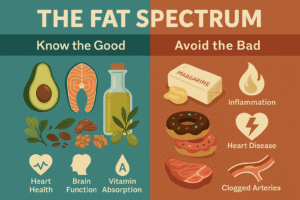
Fats have often been misunderstood in the world of nutrition. While the word “fat” might sound like something to avoid, the reality is that healthy fats are absolutely essential for your body to function optimally.
🔧 Role in the Body
- Fats are a primary energy source, especially during rest or low-intensity activities.
- They’re crucial for cell membrane integrity, helping every cell in your body maintain its structure and signaling ability.
- Fats enable the absorption of fat-soluble vitamins (A, D, E, and K), which can’t be used by the body without dietary fat.
- They also support hormone production, temperature regulation, and nerve function.
Recommended Intake:
- Fats should make up 20–35% of your total daily calories.
- Prioritize unsaturated fats (especially omega-3s), and minimize intake of saturated and trans fats.
💡 Did You Know? Omega-3 fatty acids (found in walnuts and flaxseeds) are essential for brain and heart health. Learn why omega-3s are so essential and how to add them to your diet →
4. Water
- Role: Vital for digestion, nutrient transport, and body temperature regulation.
- Sources: Water-rich foods (fruits/veggies), beverages, and pure water.
- Recommended Intake: About 2.7–3.7 liters/day depending on gender, climate, and activity
Want to learn how water powers your body, how much you need, and how to hydrate smartly?
→ Read our complete guide to water and hydration →
Micronutrients: Small But Mighty
🧪 Vitamins
Each vitamin plays a unique role. Some key examples:
- Vitamin A: Vision, immunity, reproduction.
- Vitamin C: Antioxidant, collagen production, iron absorption.
- Vitamin D: Calcium absorption, bone health, immune support.
- B-Vitamins: Energy production, nerve function, red blood cell formation
☀️ Tip: You may need a supplement if you have limited sun exposure or follow a vegan diet (especially for B12 and D).
Curious about which vitamins actually boost your immunity, improve energy, or support brain health—and which ones might be overhyped?
We’ve got you covered. Explore our in-depth guide to essential vitamins and how to get them naturally →
⚙️ Minerals
These inorganic nutrients help with everything from bone formation to heartbeat regulation.
- Calcium: Bone health, muscle function.
- Iron: Carries oxygen in the blood.
- Magnesium: Muscle/nerve function, blood sugar control.
- Zinc: Wound healing, immunity.
- Iodine: Thyroid hormone production
✨ minerals may be “micronutrients,” but their impact is anything but small. From boosting your immune system and brain function to supporting heart health and metabolism, these tiny compounds power every system in your body. Curious which ones matter most and how to actually meet your needs through real food?
→ Explore our ultimate guide to vitamins and minerals →
What Happens When You Don’t Get Enough?
Deficiencies can cause a wide range of issues:
- Iron deficiency: Fatigue, impaired cognitive function.
- Vitamin D deficiency: Bone softening, immune dysfunction.
- B12 deficiency: Nerve damage, anemia, fatigue.
- Iodine deficiency: Goiter, impaired brain development in children
😰 Note: Children, pregnant women, seniors, and people with restricted diets are most at risk.
How to Get These Nutrients
✅ Prioritize Nutrient-Dense Foods
- Vegetables and fruits (rich in fiber and vitamins)
- Whole grains (for B-vitamins and iron)
- Legumes, nuts, seeds (protein, minerals)
- Fortified foods (especially for vegans and kids)
- Lean proteins and fatty fish (omega-3s, vitamin D, zinc)
📦 Read Labels & Understand DRIs
Daily Reference Intakes (DRIs) provide guidelines for optimal intake. Keep in mind that these are set for the general population, and your needs may differ based on lifestyle, medical conditions, or age
Final Thoughts: Nourishing with Intention
Eating well isn’t about counting every calorie or buying expensive superfoods—it’s about giving your body the tools it needs to thrive.
If you’re overwhelmed by dietary choices, start with this simple framework:
- Balance your plate with all macronutrients.
- Color your meals with a rainbow of fruits and veggies.
- Check your micronutrient needs, especially if you follow a special diet.
Want to explore personalized tips or meal guides for your family or specific needs? Check out our free resources and join the Pro Healthy Habits community today.
References
- Balch, P. A. (2023). Prescription for nutritional healing: The A-to-Z guide to supplements (6th ed.). Penguin Random House.
- Berdanier, C. D., & Berdanier, L. A. (2021). Advanced nutrition: Macronutrients, micronutrients, and metabolism (3rd ed.). CRC Press.
- Combs, G. F., & McClung, J. P. (2022). The vitamins: Fundamental aspects in nutrition and health (6th ed.). Academic Press.
- Means, C. (2024). Good energy: The surprising connection between metabolism and limitless health. Avery.
- Munoz, N., & Bernstein, M. (2019). Nutrition assessment: Clinical and research applications. Jones & Bartlett Learning.
- Ross, A. C., Caballero, B., Cousins, R. J., Tucker, K. L., & Ziegler, T. R. (Eds.). (2014). Modern nutrition in health and disease (11th ed.). Lippincott Williams & Wilkins.